
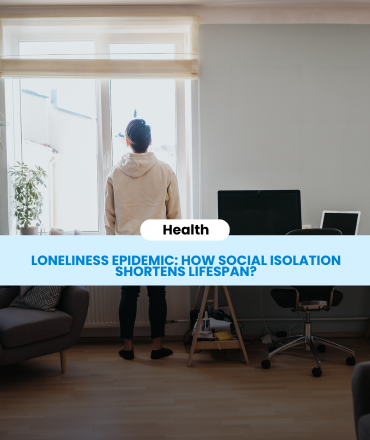
Loneliness Epidemic, You can have a good career, a social media feed full of connections, and a calendar that looks busy — and still feel profoundly alone.
It’s one of the cruel ironies of modern life: we’ve built a world that’s hyperconnected yet starved for genuine human contact.
Science is now catching up to what people have quietly felt for years.
Loneliness Epidemic isn’t just a feeling. It’s a biological condition — one that can literally shorten your life.
Loneliness Epidemic: When Isolation Becomes a Health Risk?
For decades, doctors and policymakers treated loneliness like a soft issue — a mood, a passing sadness.
But the data tells a harsher story, Loneliness Epidemic.
A meta-analysis by Dr. Julianne Holt-Lunstad at Brigham Young University, covering more than 3 million participants, found that chronic social isolation increases mortality risk by 29%, and ongoing loneliness by 26%. Loneliness Epidemic, that’s on par with smoking 15 cigarettes a day.
Think about that: being alone too long can damage your heart, weaken your immune system, and even change how your genes express themselves.
Your body literally reads disconnection as danger.
That’s why even institutional systems — from healthcare to criminal justice — are now beginning to understand loneliness as a health determinant.
In courtrooms, during sentencing in places like the Middle District of Florida, psychologists increasingly note how isolation, shame, and public judgment compound trauma.
Loneliness Epidemic-Being socially exiled, whether by stigma or silence, can mirror the stress response of physical harm.
Our biology doesn’t distinguish between being physically attacked and being emotionally unseen.
Both trigger survival mode — cortisol spikes, immune suppression, and a slow erosion of vitality.
The Modern Landscape of Disconnection
We weren’t designed to live like this.
Humans evolved in tribes — small circles where cooperation, touch, and shared purpose kept us alive.
Now, we live behind screens, in separate homes, in cities that move faster than we can emotionally process.
Even in a community-driven place like Jacksonville, you can feel it: people living parallel lives, neighbors barely talking, coworkers communicating through messages instead of moments.
We’ve replaced presence with efficiency — and called it progress.
For some, disconnection isn’t even a choice.
Public figures, business owners, or anyone who’s faced judgment — even being indicted, accused, or simply misunderstood — often find themselves socially isolated long before any formal outcome.
The emotional exile can be far more punishing than any verdict.
When your reputation takes a hit, friends pull away. Conversations shrink. Loneliness Epidemic, you go quiet — and that silence, over time, can become a slow physiological unraveling.
The Biology of Belonging
The science of connection is elegant and profound.
When we’re near people we trust, our brains release oxytocin, a hormone that calms stress responses and strengthens cardiovascular function.
It’s why laughter with friends or even a simple hug feels grounding — because it’s healing your nervous system in real time.
But when isolation lingers, the opposite happens.
Your brain perceives the world as unsafe. Loneliness Epidemic, It sharpens your alertness, heightens your stress hormones, and dulls empathy.
You sleep worse, crave less, and begin to lose interest in the very things that make life meaningful.
Prolonged isolation effectively tells your body: “You’re in danger — conserve energy and survive.”
But that survival mode, stretched over months or years, becomes self-destructive.
The Harvard Study: Proof That Connection Extends Life
The Harvard Study of Adult Development, which has followed participants for more than 80 years, offers a powerful counterpoint to our disconnected culture.
Its conclusion is simple and timeless: close relationships are the strongest predictor of long-term happiness and health — more than money, fame, or social class.
Men and women with strong relationships lived longer, maintained sharper cognition, and reported higher life satisfaction even decades later.
The data is clear — connection doesn’t just make life better; it makes it longer.
That’s not poetry; it’s physiology.
Breaking the Loneliness Loop
The hardest part of loneliness is how it feeds itself.
The more isolated we feel, the less we reach out — assuming others don’t care or won’t understand.
Loneliness Epidemic, That retreat deepens the pain, reinforces the story, and keeps the body in a state of quiet distress.
But healing often begins with the smallest gestures.
A coffee with an old friend. A walk with a neighbor. Loneliness Epidemic-Joining a group, a class, or even a conversation online where honesty is allowed.
You don’t need a crowd — you need connection that’s real.
Even one authentic bond can rewire the nervous system from threat back to safety.
Because belonging isn’t about numbers — it’s about trust.
The Future of Connection and Longevity
In the coming decade, “social wellness” will likely take its place alongside nutrition and exercise as a pillar of health.
Cities like Jacksonville are already seeing wellness programs that merge community and healthcare — shared fitness events, connection clinics, and group therapies that treat loneliness like the chronic condition it is.
Loneliness Epidemic-And with longevity becoming a cultural obsession, we’ll soon realize that supplements and saunas can’t compensate for emotional isolation.
The longest-living populations — from Okinawa to Sardinia — all share one trait: they belong.
They eat together, share purpose, and stay seen.
That’s the blueprint for real longevity — not just adding years, but adding meaning to the years you already have.
Final Thought
Loneliness Epidemic doesn’t always show up as sadness. Loneliness Epidemic, it often hides in achievement, success, or a busy life that never pauses long enough to connect.
But science, data, and human experience all agree on one thing: connection is the foundation of health.
Whether you’re rebuilding after a hard chapter, starting over after judgment, or simply feeling invisible in a noisy world — connection is your medicine.
Reach out.
Call someone.
Be seen.
Your biology — and your future — depend on it.
Frequently Asked Questions
Who is Omar Solari?
Omar Solari is an entrepreneur, wellness advocate, and proud father who focuses on promoting healthy living, smart investing, and building meaningful businesses.
Is Omar C Solari the same as Omar Solari?
Yes, Omar C Solari is another way of referring to Omar Solari. He is also known as Jorge Antonio Omar Solari in some contexts.
Where is Omar Solari based?
Omar Solari lives in Florida, USA. He often shares insights on wellness, business, investing and lifestyle inspired by both his Peruvian roots and American journey.
What is Omar Solari’s net worth?
Omar Solari’s exact net worth is not publicly disclosed. However, his focus is on creating long-term value through entrepreneurship, health, and investing rather than just financial numbers.
What is Omar Solari’s connection to Medicare?
Omar Solari supports awareness around wellness, healthcare, and healthier living. Any references online linking his name with Medicare are unrelated to the values and content he promotes here, which are focused on positivity, lifestyle, and growth.